
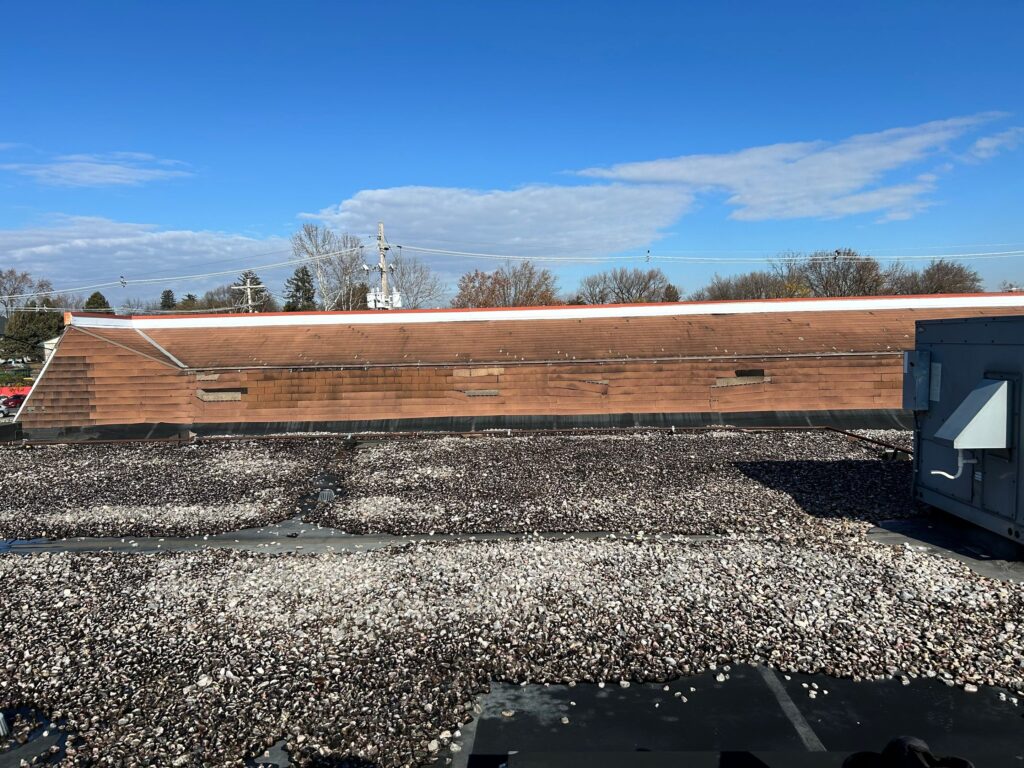
A Treasure Valley Winter Is Slower Damage, Not Always a Single Storm
Wind and hail claims usually trace back to one event. Snow and ice damage on a Boise commercial roof is often the opposite — a season's worth of freeze-thaw cycling working on the same seams, drains, and flashing details until something finally lets go. A cold night followed by a sunny afternoon can send meltwater refreezing right at a parapet or drain, and that repeated cycle is what actually opens up a roof over a winter, more than any single snowfall. Documenting that kind of damage means looking at the whole season rather than only the most recent storm.
Where Ice Dams Form on a Low-Slope Roof
Commercial roofs do not ice-dam the way a sloped residential roof does, but the same mechanism shows up at parapets, roof drains, scuppers, and any low point where meltwater collects and refreezes. Once ice builds up around a drain or scupper opening, water backs up behind it and can find its way under membrane laps, through flashing joints, or into a pitch pocket that was never designed to hold standing water. We check every drain, scupper, and parapet detail for ice staining, membrane lift, and evidence that water sat somewhere it should not have.
Freeze-Thaw Cracking and Membrane Fatigue
Boise's winter pattern — cold snaps broken up by warmer stretches — puts real stress on membrane seams, sealants, and flashing joints through expansion and contraction. A seam that looked fine in October can develop a hairline separation by February purely from that repeated movement, especially at rooftop unit curbs and pitch pockets where different materials meet. We look for that kind of fatigue specifically, since it is easy to miss on a quick visual check and easy to misattribute to age instead of weather stress.
Snow Load and Structural Signs
Heavy, wet snow accumulation is less common in the valley floor than in the surrounding foothills, but it does happen, and on an older built-up or modified bitumen roof with ponding history it is worth checking for signs of deflection, membrane stress at drains, or interior ceiling evidence that points to a structural concern rather than just a surface leak. We document what we can see from the roof and the interior and flag anything that suggests the issue goes beyond the membrane.
Building the Winter Damage Record
We're your roofing contractor, not a public adjuster — we document and substantiate the roof damage so you and your adjuster work from an accurate scope. For winter claims that means photographing drain and parapet conditions, marking interior moisture evidence, and putting a timeline together where the freeze-thaw pattern or a specific storm date is known. Property managers across Boise, Meridian, Nampa, and the Bench who schedule a post-winter inspection before the spring thaw fully sets in typically get a cleaner record than owners who wait until a tenant reports a stain.
Why Spring Is the Best Time to Document Winter Damage
Waiting until summer to look at a roof that struggled through winter means losing evidence: ice staining fades, refrozen drain areas dry out and look normal, and a tenant's memory of exactly when a ceiling stain first appeared gets fuzzy. As soon as the last hard freeze passes, a spring inspection can still catch ice staining at parapets and drains, membrane lift that has not fully relaxed back into place, and interior moisture that has not yet dried and been repainted over. That timing matters as much for a winter claim as event timing matters for a hailstorm claim.
Coordinating With Facilities and Maintenance Teams
Buildings with in-house maintenance or a facilities contract often have someone who cleared snow or noticed a drain backing up mid-winter, and that observation is useful documentation even if no photos were taken at the time. We ask about any known winter events, prior drain clearing, or reported interior issues during the season, and fold that into the written record alongside what we find on the roof itself.
Older Built-Up and Modified Bitumen Roofs
A meaningful share of Boise's older commercial buildings, particularly downtown and on the Bench, still carry built-up asphalt or modified bitumen roofs that respond to freeze-thaw differently than single-ply membrane. Granule loss, alligatoring, and blistering can all be accelerated by repeated freezing and thawing of trapped moisture within the roof assembly, and we look for that pattern specifically on these older systems rather than applying a single-ply checklist to a roof type that ages differently.
Yes. Ice damming at parapets, drains, and scuppers can back water up under membrane laps and flashing, leading to interior leaks well after the snow itself has melted.
Yes. Boise's repeated freeze-thaw swings through winter can gradually open small membrane seams, flashing joints, and sealant lines even without one large snow event.
We photograph and measure affected areas such as drains, parapets, and membrane laps, note interior moisture evidence, and record the timeline of the freeze-thaw or snow event where known.
That depends on the policy and the specific damage. We document structural or membrane effects we observe; whether snow load is a covered cause of loss is a question for the carrier.
Yes. Clogged or frozen drains and scuppers are one of the most common sources of winter roof damage, and we check them as part of every winter damage assessment.